Posts

Power and Media Industries
Image
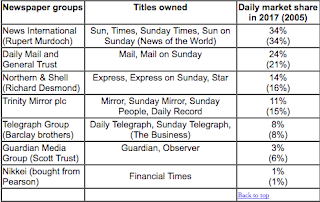
James Curran and Jean Seaton ON THE NEED FOR DIVERSITY - "diversity is in the public interest - but modern societies suffer from collective attention deficit disorders [...] the public interest has to work harder to be noticed, and we need agile but resourceful media to do that" Digital technologies have access to the internet, and this means that people have access to a much wider range of things. I good way to describe the range of media is as a MONOPOLY, and this is when someone has the exclusive ownership of something. Rupert Murdoch is the CEO of News Corporation , which owns the Sun, The Times and The Sunday Times. Not only does News Corp own these newspapers, they also own ITV, Fox, National Geographic and Sky. A conglomerate is a large corporation which consists of multiple smaller companies. A subsidiary is a smaller company owned by a larger corporation. DISNEY is a good example of a conglomerate, as they own Lucasfilm, Marvel, Pixar and Vice. By doing...

DIfferent Perspectives

Image
Why do producers use representation? To target an audience To present an ideology To make something otherwise normal more interesting To manipulate the audience In order to cultivate an ideology Entertainment value Narrative EXAMPLE QUESTIONS FOR COMPONENT 1 SECTION A: -In what ways can media products incorporate viewpoints and ideologies? -Explore how audiences can respond to and interpret the ideological perspectives of media products. PARAGRAPH STRUCTURE: - The point you are making, which links to question asked (specific, such as lexis or mise-en-scene) - The evidence , the media language that supports your point - The argument or deeper analysis of this point - A theoretical perspective which is used to confirm your point of view (not essential) <The word 'story' is used to refer to something that is 'newsworthy'> CASE STUDY - Finsbury Toddler Murder In these articles, we can see that the murder is represented di...

Newspapers

Image
There is a 'Don't Miss!' panel, which is also known as a 'Sidebar of Shame'. On The Mail Online, a few examples of articles in this sidebar are: In the article about Ola Jordan, there is a lot of lexis which is objectifying her, for example they call the calendar she's posing for as "sizzling", and as well as this the image used is very sexual. The Mail Online is usually catering for a female audience, and therefore you can see that by using a celebrity that is in the show "Strictly come Dancing", they are trying to appeal to a female audience. There is also a secondary audience of heterosexual men and therefore this means that by using this image, you can see her in a very sexual way. Images like this cultivate the ideology that women should look a certain way.

Hegemony 2

The DOMINANT IDEOLOGY is the rules we accept in society. HEGEMONY is the power exerted over us through consent and not through force. It is a system of control, and we follow systems of control all the time. Judith Butler had a hegemonic theory of gender , and she said that sex is what you're born as - you're physically male or physically female . Then there is gender, what she feels is 'a performance' . PATRIARCHAL HEGEMONY is where the males have control over society

The Study of Representation

The Study of Representation looks at: The group, place or issue on which a media text is focussing The technical devices the media uses in order to present these groups or issues The message about the group or issue being created in the text The impact of this message on the target audience The Representation in a Mail Online article http://www.dailymail.co.uk/femail/article-5099651/Scantily-clad-women-upstaged-messy-bedrooms.html In this text, we can see that it is a representation of girls, possible even teenage girls. We can see through the lexis that the author finds the girls 'sexy', as the phrase "scantily-clad stunners" is used several times within the article. By using this phrase, we can tell that it is possible written by someone who is much older, as it is not a phrase the younger generation would use. This could also imply that there is a message to the audience that girls are showing off for men and that they are doing it to impress...

Analysing Bias and the Construction of Reality in 'The Times' and 'The Daily Mirror'

Image
Bright Red masthead which identifies it as a tabloid Barcode not visible on this side of the paper Caption used in the skyline to show another devastating event Headline written over the Main Image This edition is made specifically for the election in America There is a standalone in the skyline of this paper The lead story is very clear here We can see here that there is a political bias, and the most obvious part of this is that there is a bias by headline. The headline here is trying to suggest that something bad has happened, and therefore shows a bias against Donald Trump. We can also see a bias by the photo that they used, which is of the statue of Liberty seemingly crying. This provokes their audience to show that America should be ashamed for voting Trump.  There are small captions used in the image in order to present the voters as happy The headline here is "America's Brexit" Page numbers in black boxes in corners The page furniture here is ...

Constructing Representations

Image
A newspaper has an ideology because in most cases, having an ideology rather than being neutral means that the newspaper will attract their target audience . They also have ideologies because they want to try to manipulate their audiences, and ideology is a system of control or power . It is also part of your identity , because if you carry around a certain paper it makes your identity. Another thing that ideologies are good for is that newspapers will get the support of certain political parties . TABLOID VS BROADSHEET Contains more gossip/celebrity news Contains more images Contains things you care about but you don't really need to know Much smaller size Aimed at the working classes so that they can just flick through the paper without having to pay much attention Has a Red Top, which is a stereotypical name for tabloids as most have an easily distinguishable red top/title Has a much bigger headline It is a much cheaper newspaper Contains more '...